


Power of attorney, trusted contact person and trading authority: what you need to know (national edition)
We’d all like to believe we’ll be able to stay mentally fit and manage our own financial matters throughout our lives. But deteriorating health, unforeseen events and the natural aging process mean there may be a time when you’ll need support with your financial affairs.

In Canada, you can appoint a power of attorney (POA), a trusted contact person (TCP), and/or a trading authority. Each role has different powers and responsibilities, but all of them can support you in managing your financial affairs.
Here’s an explanation of these roles and how they differ:
Power of attorney
A POA is a legal document in which the grantor authorizes one or more individuals (the attorney or attorneys) to make decisions on the grantor’s behalf during the grantor’s lifetime. This authorization may permit the attorney to make financial or personal care decisions, including decisions about healthcare and living arrangements.
Among other requirements, the grantor must be mentally capable at the time they sign any type of power of attorney for it to be valid. The legal definition of mental capacity varies based on the laws in each province or territory.
There are two types of POA:
1.Power of attorney for property: This grants certain powers to manage financial affairs.
2.Power of attorney for personal care: It allows an attorney to make decisions about personal care, such as healthcare and living arrangements, if the grantor is unable to do so.
There are two subcategories of power of attorney for property that will determine when it will take effect and for how long it will be in place.
- General POA: This can take effect immediately upon execution and ends if the grantor becomes mentally incapable or is deceased. It can also be specific or limited, applying only to a defined task (such as selling a house) or for a defined period (such as a period when the grantor plans to be out of the country).
- Enduring/durable or continuing POA: This allows the attorney to continue acting for the grantor if the grantor becomes mentally incapable. This POA takes effect either as soon as it’s signed and witnessed or only when the grantor becomes mentally incapable. It's prudent to specify how incapacity will be determined in the POA, for example, assessment by a capacity assessor, or a doctor’s note.
The attorney must act in the grantor’s best interests and can be authorized to take care of a range of tasks on the grantor’s behalf, such as managing day-to-day banking, signing cheques, buying or selling real estate, and borrowing money. The money and property continue to belong to the grantor; the grantor is simply delegating authority to manage it. It’s important to note that an attorney can’t change the grantor’s will, change a named beneficiary on a life insurance plan or a registered account, or give a new power of attorney to anyone else.
Trusted contact person
The main purpose of a TCP is to help protect your financial interests and assets by allowing your advisor to reach out to someone you trust in specific situations. Dealers are now required to take reasonable steps to obtain the name and contact information for a trusted contact person and written consent from the client to contact the TCP.
Your advisor may contact your TCP if they have concerns that you may be being financially exploited; concerns about your mental capacity and your ability to make financial decisions; to contact your legal representative, if any; or to get your contact information if your advisor is unable to locate you.
A TCP doesn't have financial decision-making authority over your accounts and can't access any account information, provide instructions on the account or transact on any of your accounts. Unlike a POA, naming a TCP is done through the dealer’s forms and is an informal arrangement.
Trading authority
Trading authority is used specifically in the context of investment accounts. It allows an individual appointed through the dealer’s forms to make trading decisions on behalf of the account holder.
The authorized individual is permitted to act in accordance with the powers outlined in the trading authorization. At Manulife Wealth, a trading authority can buy and sell securities, but they can't withdraw funds or transfer assets out of the account.
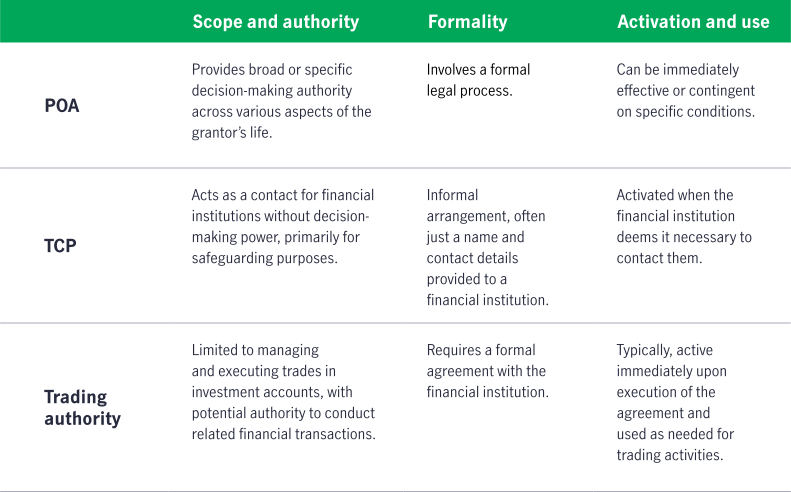
Table: Key differences
Considerations when naming a POA, TCP or trading authority
In all cases, the individual(s named as your POA, TCP, or granted trading authority should be willing, trustworthy and reliable. They also need to understand the scope of their authority and associated responsibilities. It's not advisable to name the same person as both your POA and TCP. Selecting an individual as TCP who doesn't have authority in your financial decision-making may reduce the risk of a lack of objectivity by an individual named as both TCP and POA.
Contact your Manulife Wealth advisor to learn more about POA, TCP, or granting trading authority and how they may apply to your circumstances.
Important disclosures
Important disclosures
The Advisor and Manulife Wealth Inc. and/or Manulife Wealth Insurance Services Inc. ("Manulife Wealth") do not make any representation that the information in any linked site is accurate and will not accept any responsibility or liability for any inaccuracies in the information not maintained by them, such as linked sites. Any opinion or advice expressed in a linked site should not be construed as the opinion or advice of the advisor or Manulife Wealth. The information in this communication is subject to change without notice.
MW 5216588